Search the Community
Showing results for tags 'copycat'.
Found 8 results
-
I cannot tell the differences immediately, even after taking a second look! Really is 厚颜无耻 (shameless). China ramen shop, Ichran, denies copying Japanese eatery Ichiran, asks people to 'use their eyes' Source: https://mothership.sg/2026/05/fake-ichiran-beijing-copy-japan-ramen-chain/ A ramen shop in Beijing, China, has sparked controversy after it was accused of imitating popular Japanese tonkotsu ramen chain Ichiran, from its logo to the appearance of its ramen. The shop, named “Honjitsu Ichiran Ramen”, was found in a commercial facility in Beijing, according to Japanese media reports. Ichiran, which originated in Fukuoka and is known for its Hakata-style tonkotsu ramen, has outlets in Japan, Taiwan and Hong Kong, but does not operate any outlets in mainland China or Beijing. chiran’s logo is known for its red circle and green brush-style lettering. The logo used by the Beijing shop appeared to use a similar red, green and black colour scheme. However, the logo on the Chinese food delivery platform read “ICHRAN” instead of “ICHIRAN”, with the second “I” missing, according to TV Asahi News. The fake logo also included wording such as “Founded in the 65th year of the founding of the nation”, while Ichiran’s real logo states that it was founded in Showa 35. Ichiran’s ramen is typically known for its tonkotsu pork bone broth, straight thin noodles and chilli-based “secret red sauce” placed in the middle of the bowl. The Beijing shop’s ramen appeared to copy some of these features, including the red sauce, spring onions and chashu. However, the Chinese version also came with toppings not usually found in Ichiran’s standard ramen in Japan, including a halved seasoned egg, bamboo shoots, fish cake and corn, according to FNN News. Ichiran is also known for its “flavour concentration booths”, where customers sit in partitioned seats to focus on their ramen. Fuji News Network (FNN News) reported that the company has obtained a patent for this seating style. However, the Beijing shop’s interior was reportedly different, with only simple desks and chairs instead of Ichiran-style booths. The taste was also reportedly far from the real thing. After trying the ramen, an FNN News reporter said: “The soup is extremely thin. It mostly tastes like oil, and there is hardly any tonkotsu flavour. The noodles are medium-thick and have the texture of udon with no firmness.” Reviews on Chinese social media and food delivery platforms were just as harsh. One customer review, cited by FNN News, said: “What is this? It was so bad I stopped after one bite.” Another review cited by TV Asahi News said that, "the meat inside tasted sour. I was scared and spat it out immediately.” Gendai Media also cited low-rated reviews saying, "I’d be better off eating instant noodles" and “The taste is nowhere near that of the real Ichiran". FNN News said it confronted the person in charge of the Beijing shop, who denied any connection to Ichiran and rejected the suggestion that the logos were the same.' The person in charge said: “We have no connection to Ichiran. How is Ichiran’s logo and my logo the same? Look at it with your own eyes. Are you saying they’re the same? Where? Where exactly? If green, red and black are colours exclusively for Ichiran, then I have nothing to say.” A tourist from Shanghai who was interviewed in Japan also told FNN News: “I think Ichiran is famous. At first glance, the fake Ichiran looks so similar that you could mistake it for the real thing.” The shop later reportedly disappeared from searches on the food delivery app. When TV Asahi’s reporting team visited the shop, the words “Honjitsu Ichiran Ramen” were seen at the site, but no one was inside. A nearby shop staff member told TV Asahi News: “They were here yesterday. They’re closed today. It seems they’re feeling a little unwell.” TV Asahi News reported that the shop still appeared on the food delivery platform until May 19, but could no longer be found in searches on May 20. The real Ichiran has also posted a warning on its official website, calling for customers to be cautious about imitation stores. Ichiran said on its website that there are currently “no stores in mainland China” and that it has “no relationship whatsoever” with such imitation stores. The company added that it has confirmed the existence of stores “that appear to imitate” Ichiran’s logo, signboards, shop interiors and product names, and warned customers to check its official website for the latest list of authorised outlets. Copycat shops resembling Ichiran have surfaced in China before, according to Gendai Media, including one called “Ranchi” that opened around 2018 and reportedly copied Ichiran’s booth seating system, ticket vending machine, water dispensers, cups and order sheets.
- 20 replies
-
- 10
-
.png)
-
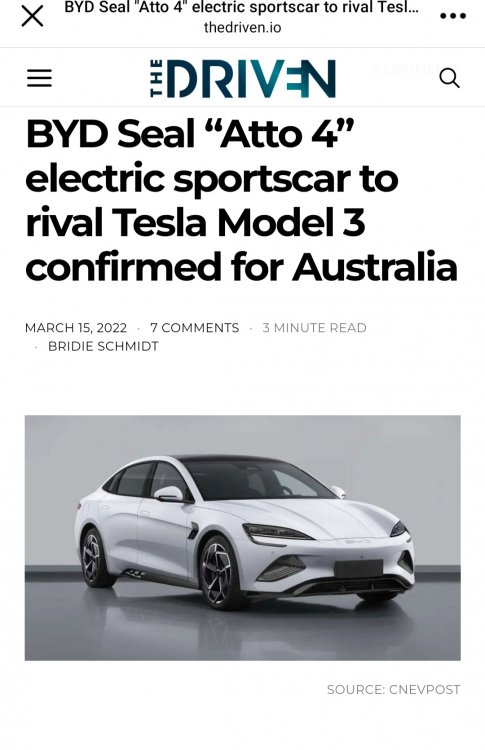
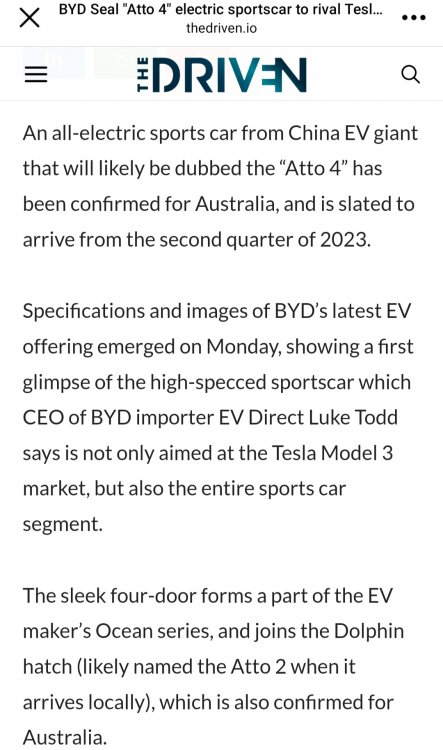
https://thedriven.io/2022/03/15/byd-seal-atto-4-electric-sportscar-to-rival-tesla-model-3-confirmed-for-australia/amp/ China doing what they do best, copying According to the source, this can do 0-100 in 3.9 s
-
 SEOUL, June 12 (Yonhap) -- A former senior executive of Samsung Electronics Co. has been arrested and indicted for stealing the chip giant's trade secrets to build a copycat chip plant in China, prosecutors said Monday. The 65-year-old former executive, whose name is withheld, was charged with violating the industrial technology protection and unfair competition prevention laws, according to the Suwon District Prosecutors Office. He is accused of attempting to build a complete copy of Samsung's semiconductor factory in China after illegally acquiring the company's confidential data, including chip plant basic engineering data (BED) and process layout and design drawings, from August 2018 to 2019. The prosecution also indicted six other people -- one employee of a Samsung Electronics subcontractor and five employees of a Chinese chipmaker established by the former executive -- without detention on charges of colluding in the alleged technology leak. BED is a technology needed to ensure impurities do not exist in semiconductor manufacturing facilities. Process layout contains information on the floor plan and dimension of a chip plant's eight core processes for semiconductor production. Such trade secrets essential for the manufacturing of sub-30-nano DRAM and NAND flash chips are considered national core technologies. According to prosecutors, the former executive had attempted to use the stolen technologies and data to build a copy of Samsung Electronics chip plant just 1.5 kilometers away from the company's chip plant in Xian, western China. But his plan failed to materialize as a Taiwanese company broke its promise to invest 8 trillion won (US$6.2 billion) in the project, they said. Instead, the former executive reportedly received an investment worth 460 billion won from Chinese investors and produced trial products from a chip manufacturing plant built on the basis of Samsung technology in Chengdu last year. His Chinese chip plant is known to have hired about 200 people from Samsung and SK hynix Inc. He allegedly instructed his employees to obtain and use Samsung's semiconductor design data and other trade secrets and they participated in the crime according to his instructions, prosecutors said, estimating Samsung suffered damage of at least 300 billion won due to the technology leaks. https://en.yna.co.kr/view/AEN20230612005100315
 -
http://uk.youtube.com/watch?v=0-JULFxB0sk http://www.japanprobe.com/?p=1678
-
China made car rebadged to become continental. club.auto.163.com/bbs/auto_aaac/39821297.html
-
-
Pls see this http://blog.sina.com.cn/u/4b671d0b010008i8 if these cars come to spore, will u buy? i feel if i own 1
-
Story from Straits Times. Interestingly, cloning does not produce duplicates, even in appearance. Same genes, but cloned kitty shows she's no copycat She may be a genetic twin, but cc is still different from the original, in behaviour and even in looks COLLEGE STATION (Texas) - Rainbow the cat is a typical calico with splotches of brown, tan and gold on white. Her clone, cc (for carbon copy), has a striped grey coat over white. Rainbow is reserved while cc is curious and playful. Rainbow is chunky; cc is sleek. The Humane Society might be inclined to say: I told you so. But then, so would cc's creators at Texas A&M University. Sure, you can clone your favourite cat. But the copy will not necessarily act or even look like the original. The clone is just over a year old. Her birth on Dec 22, 2001, was big news when it was announced last February because it was the first time a household pet had been cloned. Previous mammal clones were barnyard animals like cows and goats. The creation of cc was funded by Genetic Savings & Clone, a company that hopes to make money from people's desire to duplicate their favourite pets. Last February, in the journal Nature, the A&M researchers published details of the project and DNA test results that showed cc was a clone. But people who hope cloning will resurrect a pet will be disappointed, said A&M animal cloning expert Duane Kraemer. Experts say environment is as important as genes in determining a cat's personality. And as far as appearance goes, having the same DNA as another calico cat does not always produce the same coat pattern. All of which has led to the Humane Society saying this proves its opposition was valid all along. Said senior vice-president Wayne Pacelle: 'This vindicates the opposition we espoused from the beginning, that cloning does not lead to duplication. 'There are millions of cats in shelters and with rescue groups that need homes, and the last thing we need is a new production strategy for cats.' Before the birth of cc, Genetic Savings & Clone had hundreds of pet DNA samples stored at a cost of US$895 (S$1,610) for healthy animals and US$1,395 for sick or dead animals. Chief executive Lou Hawthorne has estimated that the cost to create a clone will initially be in the low five figures and later drop to the low four figures. Though cc's arrival sparked a deluge of calls from pet owners, more research is needed to figure out how to produce consistently-healthy clones before the company can start doing it commercially, said company spokesman Ben Carlson. There is a demand from dog lovers, but scientists so far have been unable to clone a canine. Mr Carlson said the company tells pet owners that cloning will not resurrect their pet, and that the company has turned away some customers. However, he said cloning could reproduce what a pet owner considers to be exceptional genes, particularly from an animal with unknown parentage or one that has been spayed or neutered. Recently, a major funding source was shunted, and A&M will continue trying to break new ground in cloning farm animals, wildlife and dogs, but it is finished with cats and any commercial pet venture. As for cc, the scientists say she has shown no signs of genetic defects. Then again, the copycat has been protected by a sterile environment all this time. She will eventually move in with Dr Kraemer and his wife. In time, they plan to breed cc but, this time, they will just be looking for the right tom. --AP